



Summary
Customer communication software pulls every channel your customers use, WhatsApp, Instagram, Messenger and webchat, into one shared inbox so your team answers from one screen instead of four logins. Most platforms add automation, routing and reporting on top. Companies start looking once response times slip or customers expect WhatsApp and the current setup can't offer it. Saysimple is built for exactly that moment.
TL;DR
- Customer communication software centralizes WhatsApp, Instagram, Messenger and webchat into one inbox for your whole team.
- Automation and smart routing sit on top, so a conversation reaches the right person without someone forwarding it by hand.
- Teams usually start shopping once response times slip, phone queues back up, or customers expect WhatsApp as a channel.
- Integrations, data residency, pricing model and support language are the four things worth checking before you commit.
Picture a small customer service team on a Monday morning. A shared WhatsApp Business phone sits on someone's desk, Instagram DMs get checked whenever someone remembers, the website chat has its own login, and the phone just will not stop ringing. Nobody owns the full picture, so the same customer question gets answered twice, or not at all.
That fragmentation used to be a minor annoyance. It no longer is. More customer conversations now start on WhatsApp or webchat than on the phone, and a team spread across disconnected tools cannot keep up with that shift for long.
Customer communication software exists to close that gap. The rest of this guide walks through what it actually is, why teams end up looking for one, what to expect from a modern platform, and what to check before you buy.
What Is Customer Communication Software?
Customer communication software is a platform that brings the channels a business uses to talk with customers, such as WhatsApp, Instagram, Messenger and webchat, into one shared inbox, then layers automation, routing and reporting on top. Instead of separate logins and separate inboxes, your team works from one screen, and a conversation that starts on webchat sits right next to your WhatsApp chats, so nobody loses the thread.
Saysimple, for example, is a B2B Commerce Customer Engagement Platform: one omnichannel inbox for WhatsApp Business, Instagram DM, Facebook Messenger and webchat, powered by AI and automation, with WhatsApp at the heart of it. It is one concrete answer to the category; Trengo, CM.com and a handful of others answer it differently, usually with their own mix of channels, pricing model and depth of automation.
Why Teams End Up Looking For This
The trigger is rarely abstract. A support team's response time creeps from minutes to hours. A sales team loses a lead because the WhatsApp message landed on someone's personal phone over a weekend. A manager cannot tell how many conversations the team actually handled last month, because half of them never touched a system that counts.
WhatsApp is usually the specific pressure point. Customers now expect it as an option, and running it from a personal phone or the free WhatsApp Business app works until a second person needs access, or until a message needs to be answered outside office hours. That is where a shared inbox like Saysimple's pays off right away: the whole team works on the same WhatsApp number, with conversations assigned to the right person automatically. Trengo, the long-standing Dutch option in this space, built its early growth on exactly that need. Its own pricing has climbed since, with conversation-based fees that can add up fast once a team runs a WhatsApp campaign or a seasonal peak, which is the specific gap a flat-fee alternative like Saysimple is built to close. To be fair, if your volume is low and steady, Trengo's base plan can still come out cheaper than a flat-fee alternative; the economics flip once a campaign or a seasonal spike pushes volume up.
What to Expect From a Modern Platform
Most platforms in this category share a core set of building blocks, even if the depth varies.
| Feature | What it does | Why it matters |
|---|---|---|
| Omnichannel inbox | Merges WhatsApp, Instagram, Messenger and webchat into one screen | No more logging into four apps to find one reply |
| Smart routing & automation | Assigns each conversation to the right team or person automatically | Conversations stop sitting in the wrong queue |
| Reporting & analytics | Tracks response time, volume and workload per agent | Makes it visible where conversations actually get stuck |
| CRM/ERP integrations | Syncs contact and order data with the systems you already run | Agents see order history without asking the customer to repeat it |
The Saysimple Shared Inbox for WhatsApp is one working example of the first row: WhatsApp, Instagram, Messenger and webchat in one screen, with automatic routing, templates and quick replies, and no separate WhatsApp app to check on the side.
How Centralizing Communication Pays Off in Practice
Kleurrijk Wonen, a Dutch housing corporation, ran into a familiar version of this problem: tenants and house seekers calling in with questions, long phone queues, and a support team absorbing all of it by phone. They added a WhatsApp integration so tenants could send a quick message instead of waiting on hold for a repair update or a question about an available home.
The result was not a dramatic overnight fix. It was fewer phone queues, a lighter workload for the team answering them, and tenants who got an answer faster, the ordinary kind of improvement this category is actually built for. Read the full Kleurrijk Wonen case.
Choosing the Right Software: What to Check Before You Buy
Once you know you need something, four questions separate a good fit from a bad one.
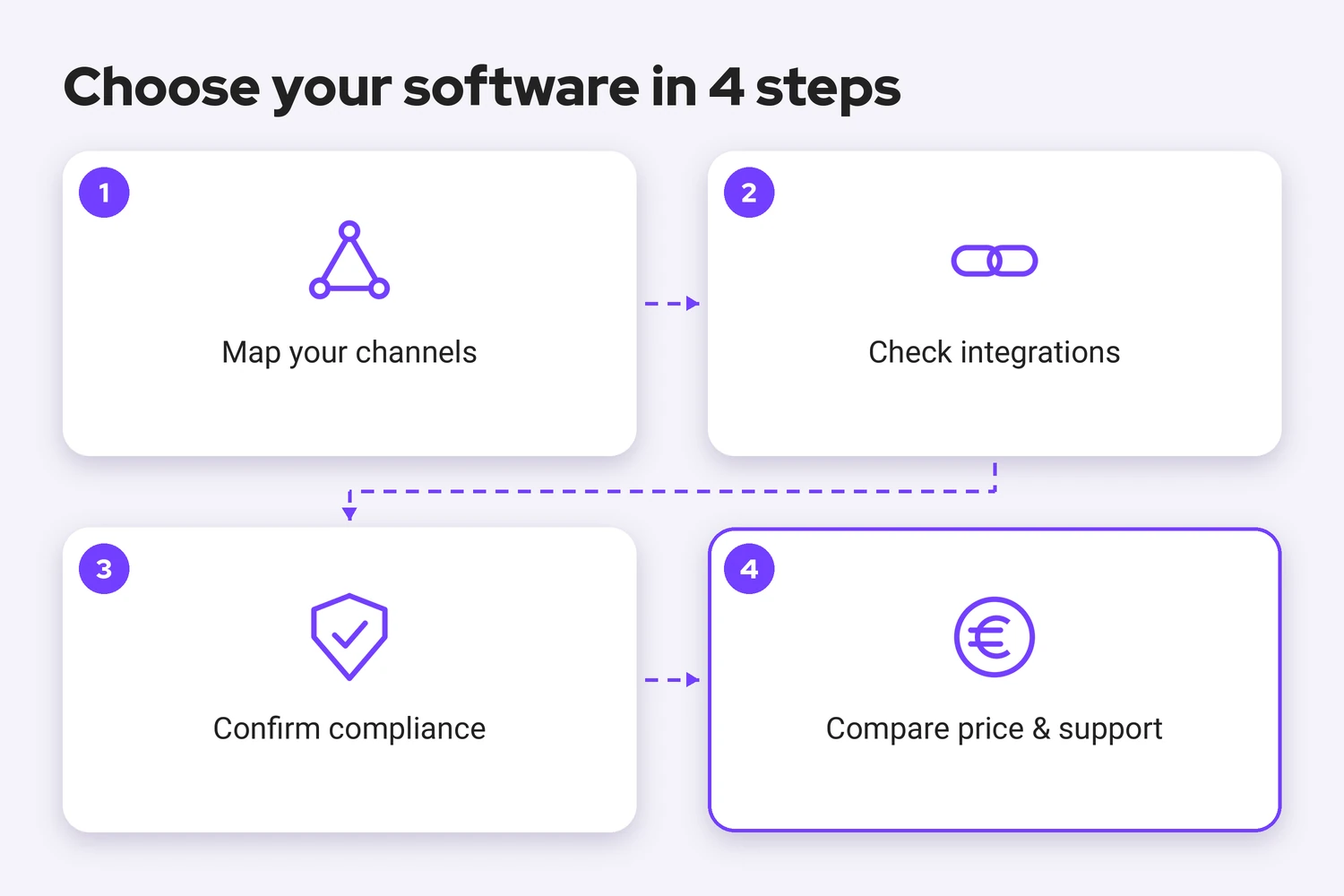
Start with your actual channels. If WhatsApp, Instagram and webchat each need their own tool today, map that out before you shop, rather than buying whatever has the most logos on its integrations page.
Check integrations next. A platform that cannot talk to your CRM or ERP without custom development will cost you later, even if the sticker price looks fine now.
Confirm compliance and data residency. Where customer data is stored, and whether that satisfies the General Data Protection Regulation (GDPR) for your market, is worth a direct answer from the vendor, not an assumption.
Finally, compare pricing model and support language together, because they tend to move in the same direction. A flat monthly fee, Saysimple's Grow plan pricing runs from €119 per month on annual billing, is easier to budget against than conversation-based pricing that climbs with every campaign. And support that actually speaks your language saves a lot of back-and-forth: Saysimple, for instance, supports customers in English, Spanish and Dutch.
Closing thoughts
None of this is really about software for its own sake. It is about whether a customer who messages you on a Tuesday afternoon gets an answer before they give up and call a competitor instead. Centralizing the channels is the first step; what a team does with that single inbox is what actually decides whether the switch was worth it.
If your team is still juggling WhatsApp, Instagram DMs and a ringing phone across separate tools, request a Saysimple demo and see how much calmer one shared inbox feels for your own channels.
Sources
- GDPR.eu, official overview of the EU General Data Protection Regulation, referenced for the data residency and compliance criteria above.
- WhatsApp Business Platform, Meta's own documentation on the WhatsApp Business Platform, referenced for how WhatsApp functions as a business messaging channel.



