


Summary
The free WhatsApp Business App and the official WhatsApp Business Platform get compared constantly, and the confusion makes sense, they share a name and a green icon. This post breaks down what actually separates them: who each one is genuinely built for, what a team gains once it grows past one person on one phone, and a short framework for figuring out which side of that line your business is actually on.
TL;DR
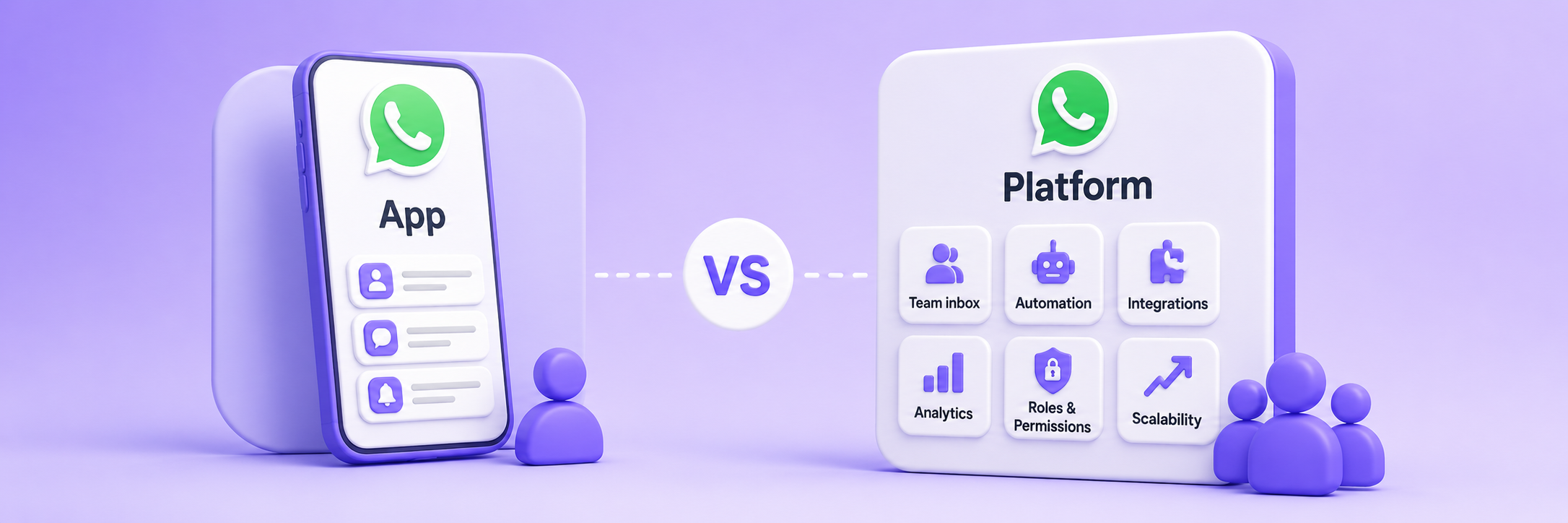
- The App is built for one person managing WhatsApp from a single phone. The Platform, often called the API, is infrastructure that a Meta approved provider like Saysimple builds a real multi user product on top of.
- The practical differences show up in shared team access, message templates, automation and bots, reporting, and how Meta verifies the business behind the number.
- The App is a solid choice for a true solo operator. Once WhatsApp is managed by a team, even a small one, you hit its limits quickly.
- Running real business volume through the free App also carries compliance and ban risk, which we cover in depth in a separate piece on WhatsApp Business App account blocks, so this article stays focused on the comparison itself.
Somebody on the team eventually asks the same question: are we still supposed to be using the free WhatsApp Business App, or should we be on the actual Platform by now? Both options carry the WhatsApp Business name, both connect to the same green app icon on a customer's phone, and both let a business send and receive messages. Past that, they are built for genuinely different situations, and picking the wrong one tends to cost more time than the comparison itself would have.
This is a complete, standalone look at that decision: what each option actually is, where they genuinely diverge in practice, who each option is actually right for, and a short way to decide which side you're on.
What the free WhatsApp Business App is genuinely built for
The free App is a genuine, well designed tool for exactly one situation: a single person running a small business from a single phone. It gives that person a business profile, a catalog, quick replies, labels, and basic automated greeting and away messages, all for free, with no setup beyond downloading the app. For a solo tradesperson, a market stall, or a one person consultancy, that is often plenty.
The App was never designed to be shared. One phone holds the account, and while WhatsApp's own linked devices feature allows up to four companion screens to view and reply, everyone using it is still acting as the same undifferentiated business, not as an identifiable person on a team.
What the WhatsApp Business Platform actually adds
The WhatsApp Business Platform, usually called the API, is not an app you download. It is infrastructure that a Meta approved Business Solution Provider builds a real product on top of. Saysimple is one of those providers, and what it adds on top of the raw API is what most businesses are actually looking for: a shared inbox, individual logins, routing, reporting, and connections to the CRM or ERP systems a growing business already runs on.
Because the number lives in the cloud rather than on one handset, it stops being tied to a single device or a single person, which is the structural change that makes everything else on this list possible.
Where the two genuinely diverge
A handful of differences account for almost every reason a team eventually switches:
| Where they differ | WhatsApp Business App | WhatsApp Business Platform |
|---|---|---|
| Team access | One login for the whole business | Every person gets their own account and role, so a manager can see who answered what. See our deep dive on WhatsApp Business with multiple users, including a customer running 120 people on one number. |
| Message templates | No template requirement | Pre-approved templates required to start a conversation outside the 24 hour customer care window, which keeps proactive messages like order updates compliant and deliverable at scale. |
| Automation and bots | Basic away message only | Real flows and bots that qualify, route, and collect information before a person gets involved. HANOS built a WhatsApp recruitment bot on Saysimple that brought in 100 applicants in its first six months. |
| Reporting | Almost no data on how a number is performing | Reports on response times, volume, and outcomes, the data an operations manager needs to run a team. |
| Verification and trust | Not eligible | Can apply for Meta's official green checkmark verification. |
Setup complexity and pricing model follow from all of that. The App costs nothing and takes minutes to configure. The Platform involves Meta's own conversation based fees plus a provider's platform fee, priced per user rather than per download, which is a real cost but buys infrastructure the free App structurally cannot offer at any price.
Who each option is actually right for
If you are a true solo operator, someone who genuinely handles every WhatsApp conversation personally, the free App remains a sensible, low friction choice. There is no shame in staying there, and no platform fee changes that.
The moment more than one person needs to answer customer messages, even two, the calculation flips. Our view is that most businesses wait too long to make that switch, usually until a shared login has already caused a missed handoff or an untraceable customer complaint, rather than moving before the first real problem shows up.
A short way to decide
Ask three questions before choosing a side. Does more than one person need to reply to WhatsApp messages, even occasionally? Does the business need to message customers proactively, for order updates, appointment reminders, or promotions, rather than only replying to inbound messages? Does WhatsApp need to connect to a CRM, ERP, or ticketing system your team already relies on? A single yes points toward the Platform. All three questions answered no, and the free App is still doing its job.
Closing thoughts
The App and the Platform are not a better and a worse version of the same product. They are two different tools built for two different scales of business, and the right choice depends entirely on how many people actually need to be behind that green icon, not on which option sounds more advanced.
Curious whether your team has already outgrown the free App? See how the WhatsApp Business Platform works through Saysimple, check what it costs on our pricing page, or book a demo to walk through your own setup.
Sources
- WhatsApp's Business Messaging Policy, which governs the opt-in, template, and automation rules that separate the App from a compliant Platform setup.



