WhatsApp Business
6 min read
WhatsApp Marketing Tips and Tricks That Earn B2B Replies




The best WhatsApp marketing tips for B2B teams are about what happens after you hit send. Message customers only when you have a reason, ask one question per message, and promise a reply time before the campaign starts. Judge results by replies handled and orders placed, not by messages delivered.
Search for WhatsApp marketing tips and you find the same list: keep it short, add an emoji, send at ten, segment your contacts. It is decent advice, and almost all of it is about the send. For a wholesaler, a dealer group or any other B2B team, the send is the cheap part. The money sits in the next ten minutes, when a customer answers and somebody has to answer back.
This post is for marketing and sales teams that sell to other businesses, known as B2B (business to business). It covers what to send, how to collect contacts who want it, what to do when replies arrive and how to tell whether it worked. One point of view runs through it, and we will defend it: a WhatsApp campaign is a staffing decision as much as a copywriting one.
A message deserves to be sent when something changed for that customer and they can act on it today. A product they bought before is back in stock. The price of their regular range moved. A delivery window shifted. A reorder moment is near, based on their own order history. Compare that with a blanket 10% discount: your buyers get that offer from every supplier, and on WhatsApp it lands next to messages from their family.
Keep each message to one question. Instead of a paragraph and a link, ask whether the customer still wants the Thursday delivery and add reply buttons for yes and no. A tap is easier than typing, and it gives your team a clean signal to act on. Send from a number your account manager really answers on, and sign with a first name. Customers answer people, not brands. We would rather send 300 relevant messages than 3,000 generic ones, and the lower volume keeps your costs and your block rate down too.
Collect the opt-in, which is the customer's permission to receive your messages, where the customer already is. Meta requires opt-in before a business starts a marketing conversation, so a bought or scraped list is a non-starter and the fastest route to blocks. The easiest places are physical ones: the counter, the delivery note, the invoice and the order confirmation.
Dusseldorp BMW shows the principle. The dealer group has 14 branches in the Netherlands and is the largest dealer group of the BMW, MINI and BMW Motorrad brands. In every branch a QR code on the counter links to the business WhatsApp account, so customers start a chat themselves (see the Dusseldorp BMW customer story). That code is meant for direct contact, not for marketing consent, but the same mechanic carries over. Put a QR code on the delivery note with one line next to it: want stock and delivery updates on WhatsApp? Scan to opt in. You can create the link and the code with our free WhatsApp link generator.
Record the date and the source of every opt-in per contact. When someone asks where you got their number, that record is your answer.
A reply is a sales conversation you did not have to start, and it goes cold quickly. Dusseldorp BMW works with a stated target: WhatsApp conversations are picked up within ten minutes. Whatever number you choose, write it down before the campaign, not after the first complaint.

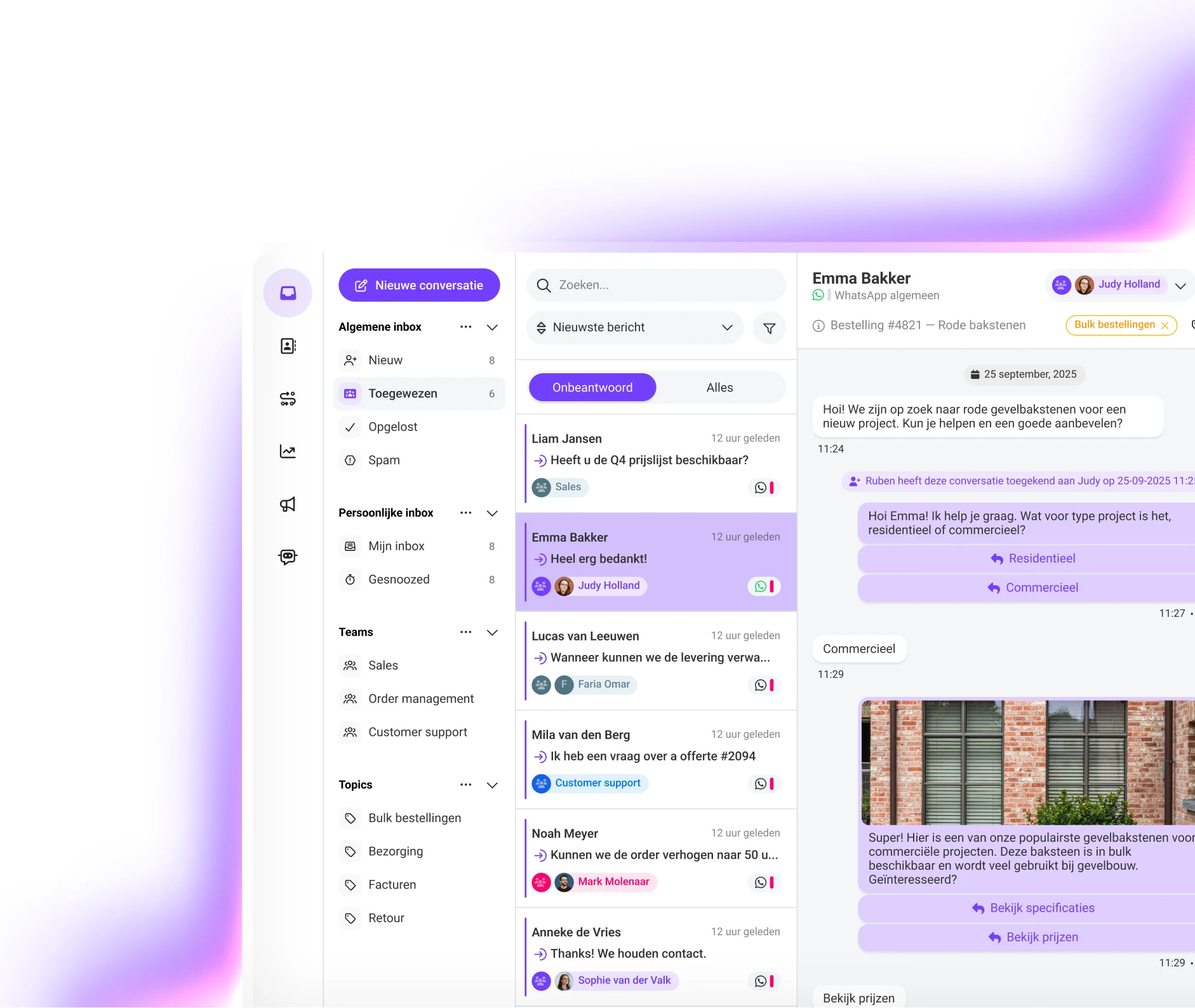
Here is the arithmetic we use to size a campaign. Message 2,000 contacts, and if one in ten answers, that is 200 conversations in a day or two. This is an illustration, not a benchmark, and your own rate will differ. The point is that your team has to be able to take that load. Send fewer messages, spread the send over a few days, or put more people on the shared team inbox. With routing, each reply reaches the right colleague instead of landing on one phone.
Automation can take the repetitive replies, such as order status. Questions about price and availability are where a person wins the sale. Put AI behind the reply and a colleague in front of it, and do it especially during a campaign.
Six habits separate campaigns that start conversations from campaigns that only produce delivery reports.
| Tip | Common mistake | Do this instead |
|---|---|---|
| Reason to send | A generic promotion to the whole list | Send when stock, price or delivery changes |
| Message design | Several questions and a long text | One question with reply buttons |
| Sender | A number without a face | A number the account manager answers, signed with a first name |
| Volume | Everything to everyone at once | Start with a small group, compare, then widen |
| Replies | Messages pile up on one phone | Shared inbox, routing and an agreed reply target |
| Measuring | Counting delivered and read | Count replies handled, quotes and orders |
Use this as a go or no go list. If you cannot tick everything, shrink the campaign until you can.
For the send itself, you can set up a campaign with WhatsApp Broadcasting in Saysimple Engage. Afterwards, the Analytics and Insights dashboard shows how fast your team replied.
Most advice on WhatsApp marketing stops where the real work starts. Pick a reason to send, ask one thing, and make sure somebody is ready when the answer comes in. Do that for one small group first, and let the replies tell you whether to widen it.
Want to see how replies, routing and broadcasts fit together in one place? Request a Saysimple demo. Saysimple is a B2B Commerce Customer Engagement Platform: omnichannel, for WhatsApp Business and other channels, powered by AI and automation.
Discover how Saysimple centralizes your customer communication, connects your teams, and automates processes.
Book a demo