


Summary
From October 1, 2026, Meta starts charging for two kinds of WhatsApp messages that have been free until now: service messages (free-form replies inside the 24-hour customer service window) and utility templates sent inside that same window. Every business phone number keeps 1,000 free service messages a month. After that, each reply costs the same as a utility template in your customer's country. For a team sending 10,000 service replies a month to customers in the United Kingdom, that works out to roughly €164 a month, up from €0 today.
TL;DR
- Service messages and in-window utility templates become billable on October 1, 2026, with every WhatsApp Business API provider, not just Saysimple.
- The first 1,000 service messages per phone number per month stay free. In-window utility templates are billed from the first one.
- 10,000 service replies a month costs about €164 in the UK, €117 in the UAE and €57 in South Africa.
- Message length doesn't change the price, message count does. Fewer, complete replies beat lots of short ones.
If your support team answers customers on WhatsApp, the 24 hours after a customer writes in have been a free zone for almost two years. Your agents, your chatbot and your order updates could reply as often as the conversation needed, and none of it showed up on the Meta invoice.
That ends on October 1, 2026. Meta is putting a price on replies inside the window, and it applies the same way to every WhatsApp Business API provider. We recently emailed our customers about it. This post covers the same ground in more detail, with the numbers you need to budget. If you want the background on how Meta's pricing categories fit together first, our guide on how WhatsApp Business API pricing works explains that. Here we stick to the change itself: what it costs and how to keep that number down.
Which WhatsApp messages start costing money on October 1?
Two types of outbound message lose their free status. Everything else about WhatsApp pricing stays as it is.
Service messages are the free-form replies your team or your AI sends while the 24-hour customer service window is open. They've been free since November 2024. From October 1, each business phone number gets 1,000 of them free per month. From message 1,001 onward, Meta charges its regional rate, which is the same rate your market already pays for utility and authentication templates.
Utility templates sent inside the window, like an order confirmation or a delivery update that goes out while a conversation is open, have been free since July 2025. From October 1, they're billed per message at the regional utility rate. The 1,000 free messages don't apply here: in-window utility templates are charged from the very first one.
It doesn't matter who writes the reply. A message from an agent, from Saysimple's AI or from a utility template is priced by what it is, not by who sent it.
How does the free allowance of 1,000 service messages work?
Every business phone number gets 1,000 free service messages per calendar month. The allowance resets at the start of each month and doesn't carry over, so if you only use 600 in October, you're back at 1,000 in November, not 1,400.
It's counted per number. A business that runs separate WhatsApp numbers for sales and support gets 1,000 free service messages on each. For a small team handling a few dozen conversations a day, that may cover most of the month. A busy support desk burns through it in the first week, and every reply after that is billed.
What will 10,000 service messages a month cost?
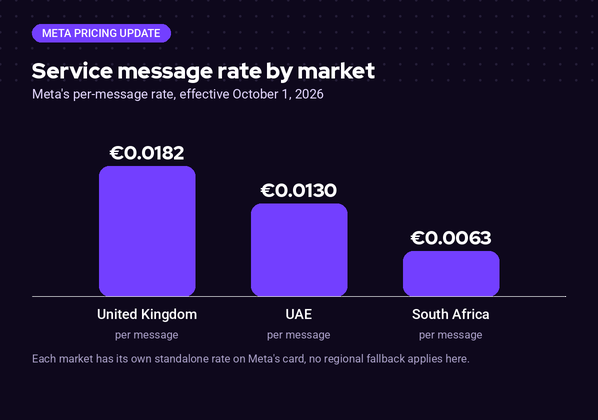
The rate depends on your customer's country, not on where your business is based. Meta prices each market separately, and service messages now follow the utility and authentication rate for that market. The chart below shows the rates for the markets in this example.
To make it concrete, we ran the numbers for a team sending 10,000 service replies a month. That's not an unusual volume: a little over 300 replies a day, spread across a support team.
| Customer market | Service messages today | From October 1, 2026 (10,000 per month) |
|---|---|---|
| United Kingdom | €0 | About €164 per month |
| United Arab Emirates | €0 | About €117 per month |
| South Africa | €0 | About €57 per month |
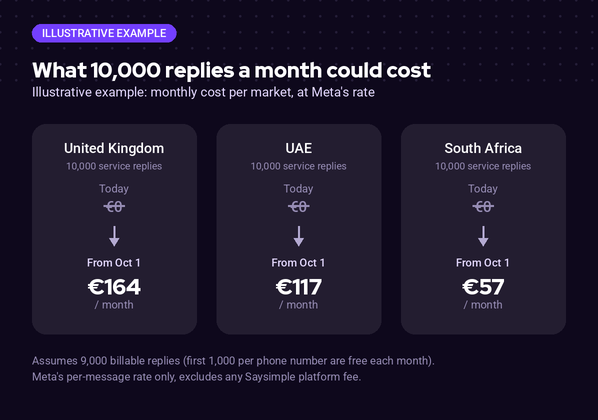
These are rounded estimates for service messages only. In-window utility templates come on top, since those are billed from the first message. Meta publishes the exact rate for every country in its WhatsApp rate card, and it's worth checking the markets most of your conversations come from.
What isn't changing?
Messages your customers send you stay free, as they always have. The 72-hour free window that opens when someone contacts you through a Click-to-WhatsApp ad or a Facebook Page button is unaffected too, so replies inside that window remain free. Outside the 24-hour window, template rules stay the same: marketing, utility and authentication templates you send to start a conversation are billed exactly as before.
How to keep your WhatsApp costs in check
Meta charges per message, not per word. Our view: after October 1, the most expensive habit isn't writing long replies, it's chopping one conversation into lots of small messages. Three things help most.
Bundle your replies
A customer who asks about delivery times, returns and an invoice doesn't need three separate answers. One clear message that covers all three costs a third as much and is usually easier to read. The same goes for greetings: "Hi Anna" followed by the actual answer in a second message is two billable messages.
Clean up your automated workflows
Check which automations send service messages inside the 24-hour window. Confirmation pings, "we'll get back to you" follow-ups and bots with lots of separate steps all add up. Set up welcome and away messages based on your opening hours deliberately, so you send one useful message instead of several reactive ones.
Stop sending by accident
Turn off "send on Enter" while typing. An agent who hits Enter halfway through a thought sends the reply in two or three parts, and each part now counts. Since length has no effect on cost, there's no reason to keep replies artificially short either. Write the complete answer and send it once.
Closing thoughts
For most teams this is a new line on the invoice, not a crisis. The teams that already write complete answers and keep their automations lean will notice it least. Look up how many in-window replies you send per phone number per month, put that next to the 1,000 free messages, and you'll know within minutes whether October changes much for you.
Want to know what your own volume will cost? Estimate it with the Saysimple WhatsApp Pricing Calculator or book a Saysimple demo and we'll walk through your setup with you. Already a customer with questions about your own usage? Email our support team at support@saysimple.com.
Sources
- Meta for Developers: Pricing on the WhatsApp Business Platform, for the October 1, 2026 changes to service messages and in-window utility templates, the 1,000 free service messages and the per-country rate cards.



