


Summary
The WhatsApp Business API doesn't have a single, obvious integration point. It reaches your business through a Business Solution Provider like Saysimple, authenticates with API keys and headers rather than a login screen, and exchanges most of its data through webhooks instead of a connection your systems keep open. For an IT team, integrating it well means settling who owns the number, which systems it should actually reach, and how the data stays governed once it starts flowing into a CRM or ERP. At Saysimple customer Volvo Nieuwenhuijse, connecting WhatsApp to their internal IDAS system meant staff stopped having to ask a customer which vehicle or department a conversation was even about.
TL;DR
- The WhatsApp Business API connects through a Business Solution Provider, not a downloadable app. Access runs on API keys, request headers, and event driven webhooks rather than a live socket connection.
- Starting a new conversation always requires an approved message template first; only replies inside an open window can be sent freely.
- Real integration reaches your CRM or ERP, not just your WhatsApp inbox. At Volvo Nieuwenhuijse, matching WhatsApp inquiries to the right customer and vehicle record automatically removed a step every conversation used to start with.
- Governance, who owns the number and which roles can see what, matters as much as the technical connection, especially once more than one system depends on it.
An IT team eventually gets some version of the same request: sales or support wants WhatsApp connected to the CRM, and could that be ready by next sprint. On paper it looks like any other integration, drop in an API key, map a few fields, done. In practice, the WhatsApp Business API works differently enough from a typical REST integration that teams who treat it that way usually end up rebuilding parts of it a few months in.
Connecting the WhatsApp Business API isn't a single integration task, it's an architecture decision that touches authentication, message rules, and who in the business is allowed to see what. That distinction matters more the moment a second system, a second department, or a compliance requirement enters the picture.
This piece walks through what actually happens when the API connects to your systems, what that connection looked like for one Saysimple customer, and the governance questions worth settling before the first webhook fires.
What Connecting the WhatsApp Business API Actually Involves
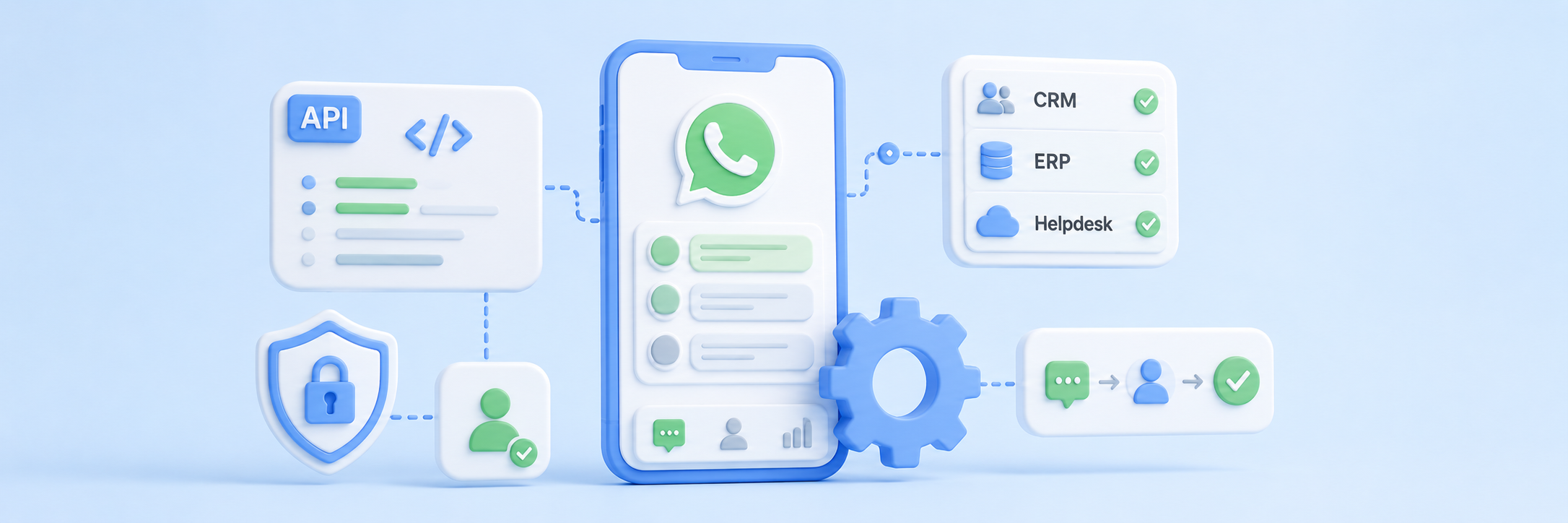
The WhatsApp Business API isn't an app your team installs and configures once. It's infrastructure you connect to through a Meta approved Business Solution Provider like Saysimple, which handles the underlying Meta relationship and gives your systems a stable, documented way in. There's no separate download, and no admin panel where the integration lives on its own; the provider's own custom integration layer is what your CRM, ERP, or internal tools actually talk to. See the full list of systems it already connects to on the integrations page.
That matters for how a project gets scoped. Instead of asking how to connect to WhatsApp, the more useful question for an IT team is which of its systems actually need to see this data, and in what order they should get it. A support inbox needs conversations in real time. A CRM usually just needs the outcome once a conversation resolves. Treating those as the same requirement is where a lot of integration timelines slip.
How the Data Actually Moves: Auth, Webhooks, and Templates
Every request to the API runs through two required headers, Authorization and X-API-Key, and most integrations set these once at the collection level in a tool like Postman rather than repeating them per call. Outbound sends go through a single endpoint; almost everything else comes back the other way, as a webhook, not something your systems poll for.
The webhook events fall into two groups your team will actually build against:
| Group | Event | Fires when |
|---|---|---|
| Message lifecycle | entry::received | An inbound message arrives. |
entry::sent | An outbound message leaves your system. | |
entry::delivered | WhatsApp confirms delivery to the recipient's device. | |
entry::read | The recipient reads the message. | |
entry::declined | A message fails or is rejected. | |
| Chat lifecycle | chat::created | A new conversation thread starts. |
chat::assigned | A conversation is assigned to an agent. | |
chat::unassigned | A conversation is unassigned from an agent. | |
chat::archived | A conversation is archived. | |
chat::unarchived | An archived conversation is reopened. |
One detail worth building around from day one: attachment URLs included in a webhook payload are only valid for about a minute after they're served. An integration that queues attachment processing for later, rather than pulling the file the moment the webhook lands, will quietly start failing on exactly the messages that matter, the ones with a photo or a document attached. It's a small detail, and also exactly the kind of thing that only shows up once you've actually built against the API rather than read the marketing page for it.
There's also a rule that shapes how your systems are allowed to start a conversation at all: any message sent outside an open reply window needs an approved message template first. That's not a Saysimple restriction, it's how WhatsApp's own customer care window works, and it means your integration needs a template management step, not just a send function.
What a Real Integration Looks Like
The clearest sign an integration is worth the effort isn't whether the message sends, it's what happens the moment the conversation opens on the other end. Volvo Nieuwenhuijse, a BMW and Volvo dealer group in the Netherlands, connected Saysimple's Smart Routing to their internal IDAS system so an incoming WhatsApp inquiry is automatically matched to the right customer, department, and vehicle record before anyone even opens the chat.
The result, in the team's own account, is faster and more informed remote assistance: staff know which department and vehicle a conversation relates to immediately, instead of starting every reply by asking. That's the actual payoff of doing the integration properly. Not that WhatsApp works, but that it stops being a blank conversation your team has to reconstruct context for every single time.
Security, GDPR, and Who Should Own the Number
Once WhatsApp conversations start flowing into a CRM or ERP, the questions that matter shift from whether it connects to who can see this, and where it lives. A WhatsApp Business number that started as one person's workaround rarely comes with any of that decided, which is exactly the gap that causes friction later, at a compliance review or when the original owner leaves the team.
A properly integrated setup gives IT a way to answer those questions directly, through role based access so permissions live with the platform rather than a shared login, and a centralized record of conversations instead of one scattered across personal devices. That's not a minor detail. It's the difference between WhatsApp being one more governed channel, and being the one channel nobody in IT can actually account for.
Build It Yourself or Go Through a Provider: What Actually Differs
Every IT team evaluating this eventually faces the same fork: connect directly to Meta's own Cloud API, or go through a Business Solution Provider that manages that relationship and adds a usable layer on top. Both are legitimate paths, but they answer different questions well.
| Question | Direct Cloud API | Business Solution Provider |
|---|---|---|
| Who maintains the integration when Meta changes something | Your team | The provider absorbs most of it |
| Who builds the shared inbox, routing, and reporting layer | Nobody, the raw API gives you messaging only | Comes with the provider |
| How fast template approval and number verification actually move | Varies mostly by how prepared your business documentation is, not by path | Same as direct, varies mostly by documentation |
| What happens to governance and permissions as the team grows | You build role management yourself | A provider like Saysimple ships it |
Neither path is automatically wrong. A small technical team with one clear use case can manage a direct connection well. A business connecting WhatsApp to multiple departments and systems, the more common case once IT gets involved at all, usually gets to a working, governed setup faster through a provider built for exactly that.
Closing Thoughts
The WhatsApp Business API rewards teams who treat it as infrastructure from the start, not as a messaging feature they'll harden later. Authentication, webhook handling, and governance aren't separate concerns from getting WhatsApp connected, they are what getting it connected properly actually means.
Curious what a properly governed WhatsApp Business API integration looks like against your own CRM or ERP? Book a demo with Saysimple and we'll walk through what it takes for your specific systems.
Sources
- WhatsApp's Business Messaging Policy, on the customer care window and the template requirement for business-initiated conversations referenced above.



