


WhatsApp has long been the go-to channel for businesses wanting fast, personal customer contact. But let's be honest: phone numbers have always felt like a slightly awkward handshake. Your customer can't message you without handing over their personal number — and that friction has quietly pushed users towards privacy-first alternatives like Signal and Telegram.
That changes now. From July 2026, WhatsApp is rolling out usernames and Business-Scoped User IDs (BSUIDs) — and if your business uses WhatsApp as a service or sales channel, there are a few things you'll want to understand before your next inbound message arrives with no phone number attached.
Don't worry: this isn't a crisis. It's actually a sign of WhatsApp maturing as a business channel. Here's everything you need to know, without the tech jargon.
Summary
From July 2026, WhatsApp is introducing optional usernames and Business-Scoped User IDs (BSUIDs), letting customers message businesses without sharing their phone number. Existing phone-number-based conversations keep working as before, but businesses will need their CRM or communication platform to also recognize BSUIDs as a valid customer identifier. Saysimple is already built to handle multiple identifier types, so conversations won't get lost as usernames roll out.
TL;DR
- From July 2026, WhatsApp users can adopt an @username and message businesses via a BSUID instead of a phone number.
- BSUIDs are scoped per business, permanent, and always included in inbound messages going forward.
- Existing contacts, phone-number-based conversations, and authentication messages are unaffected.
- Make sure your CRM or platform can store and match on both phone numbers and BSUIDs, especially in routing and automation flows.
First — what exactly is a WhatsApp username?
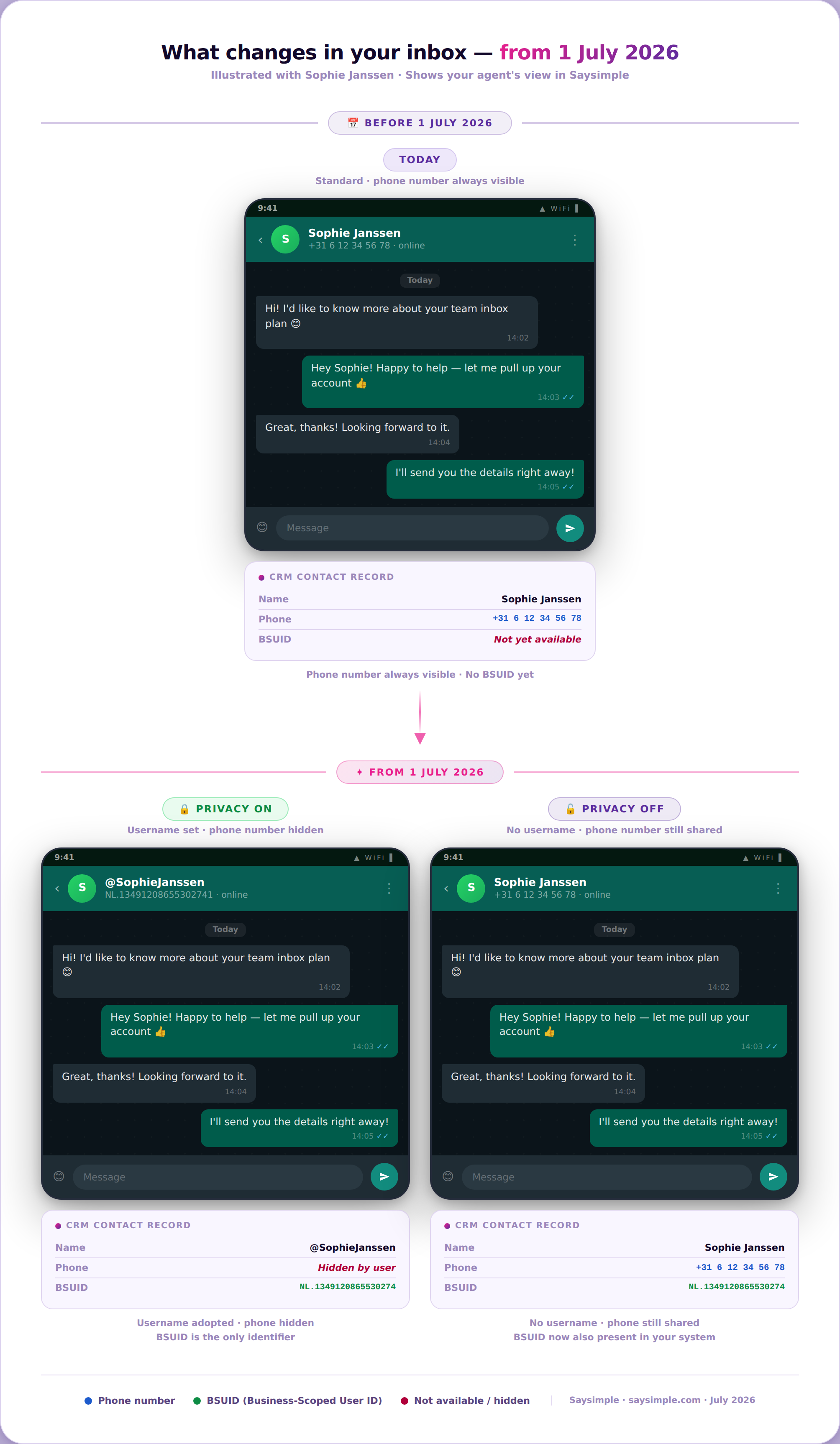
Starting this summer, WhatsApp users can choose an optional @username — think @SophieJanssen — and use it to start conversations with businesses without revealing their phone number.
It's completely optional. Users who don't set a username keep everything exactly as it is today. But for the users who do? They'll reach out to you with their WhatsApp username only — and instead of a phone number, your platform receives something called a BSUID.
So what is a WhatsApp Business-Scoped User ID (BSUID)?
A WhatsApp Business-Scoped User ID (BSUID) is a unique identifier that WhatsApp automatically generates for every user-business combination. Think of it as a stable, anonymous customer ID — similar to the IDs your CRM already uses, but issued by Meta specifically for WhatsApp interactions.
A few things that make BSUIDs smart by design:
- Scoped per business: The same person messaging two different companies receives two different BSUIDs. Sophie is NL.13491208655302741918 to you, but a completely different identifier to your competitor. Privacy, by design.
- Permanent: Even if Sophie later removes her username, her BSUID stays the same. The conversation history doesn't break.
- Always present: From July 2026 onward, every inbound WhatsApp message will include a BSUID — regardless of whether a phone number is shared or not. This actually makes BSUIDs more reliable as a customer identifier than phone numbers, which can change.
| Identifier | What it is | Stays the same if the username changes? |
|---|---|---|
| Phone number | The customer's real WhatsApp number, shared whenever no username is set | Not applicable — it's the number itself |
| Username (@handle) | An optional public handle the customer chooses and can show instead of their number | No — can be changed or removed at any time |
| BSUID | A business-scoped ID Meta generates automatically for each customer-business pair | Yes — permanent, even if the username changes |
What stays exactly the same?
Before you start worrying — the vast majority of your existing customer conversations won't change at all. Here's what remains untouched:
- Outbound messages to customers you already know via phone number continue working normally.
- Existing contacts who don't adopt a username? No change whatsoever.
- Authentication messages (one-time passcodes, verification flows) stay phone-number-only.
- Your WhatsApp Business profile phone number remains visible to customers.
- Conversations you started within the last 30 days still include phone numbers on reply.
What's new — and what to prepare for?
Here's where it gets interesting. If a brand-new customer finds you via a Click-to-WhatsApp ad or searches your business on WhatsApp, and they've set a username — you'll receive a BSUID instead of a phone number. That's it. Your team will see the username, your platform will log the BSUID, and the conversation flows normally from there.
The key thing to understand is this: your CRM or customer communication platform needs to be able to handle a BSUID as a primary identifier — not just a phone number. If your contact-matching logic today is purely phone-number-based, a username-adopting customer will look like a brand-new contact every single time.
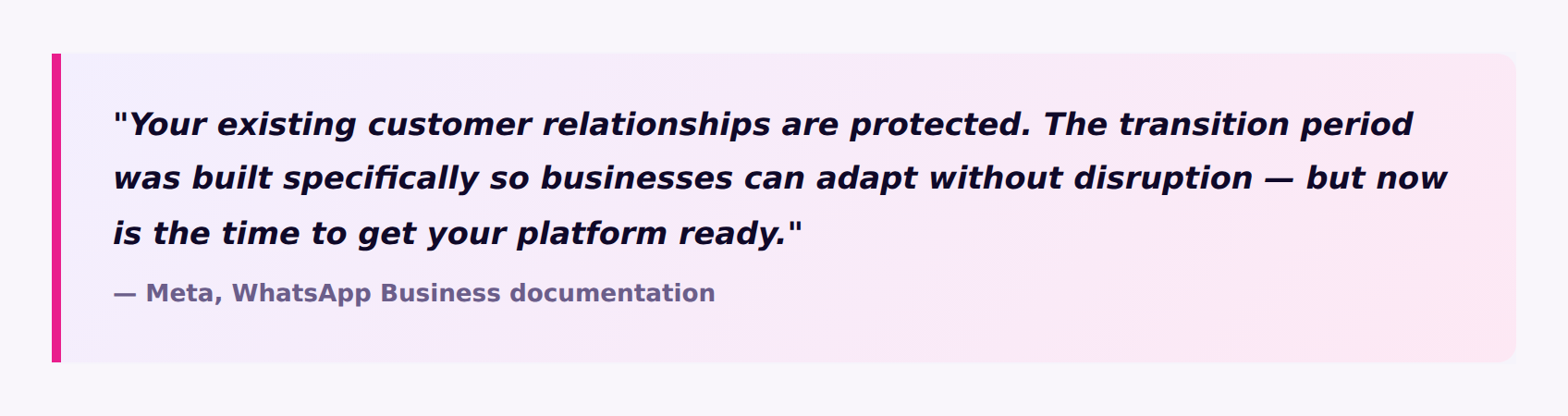
The good news? Meta has already thought about this. Their Contact Book feature (launched April 2026) automatically pairs your existing customers' phone numbers with their newly-assigned BSUIDs during the transition period. So anyone who has already messaged you before won't suddenly become a stranger.
Rollout timeline at a glance
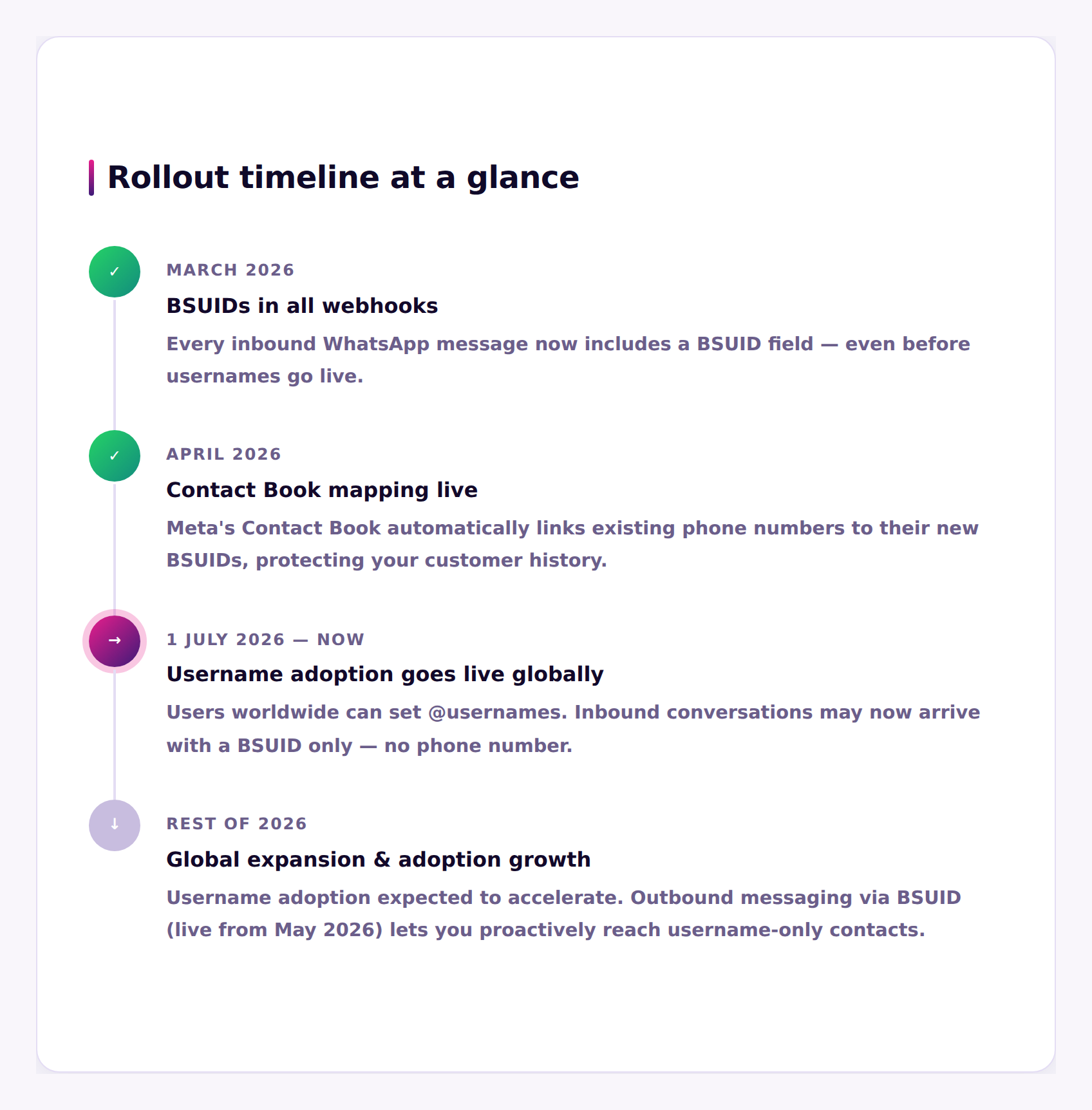
Meta is rolling out WhatsApp usernames and BSUID support in phases throughout 2026. Here's what to expect and when each milestone takes effect:
What this means for Saysimple users
If you're managing your customer conversations through Saysimple, you're in a good position. Our platform is already built around the idea that customers come through multiple channels with multiple identifiers — and a conversation should never get lost because an ID format changed.
Here's our practical advice for your team right now:
Your 3-step readiness checklist
- Check your contact profiles:Make sure your CRM or Saysimple contacts can store both a phone numberanda BSUID. Both should be able to pull up the same customer record.
- Brief your team:Agents may start seeing @usernames instead of phone numbers in the contact header. That's normal — it just means this customer values their privacy. The conversation works exactly the same.
- Review automation flows:If you have chatbots or routing rules that rely on phone number lookup, test what happens when that field is empty. A BSUID should be the fallback identifier.
Closing thoughts
Privacy features like this are a long-term win for businesses, not a threat. When customers feel safe contacting you without handing over personal data, they're more likely to reach out — not less. The businesses that adapt quickly will be the ones with fuller inboxes, not emptier ones.
WhatsApp has 3+ billion users and is still growing as a business channel across Europe, LATAM, and Southeast Asia. The introduction of usernames signals that Meta is serious about making it a sustainable, trusted platform for customer communication — and that's exactly the kind of channel you want to be investing in.
From frustration to efficiency — that's what Saysimple is all about. And with BSUIDs, you get one more stable, reliable way to keep your customer conversations running smoothly, no matter which identifier they arrive with.
Ready to future-proof your WhatsApp setup?
Talk to one of our specialists about how Saysimple handles BSUIDs, usernames, and every other identifier your customers might bring — so you never miss a conversation.
Sources
- WhatsApp's official announcement on reserving a username, on how the optional @username feature works for users.
- Meta's documentation on Business-Scoped User IDs (BSUIDs), on how BSUIDs are generated, scoped, and persisted per business.



